When You Know What You Need to Do… But You Still Feel Stuck
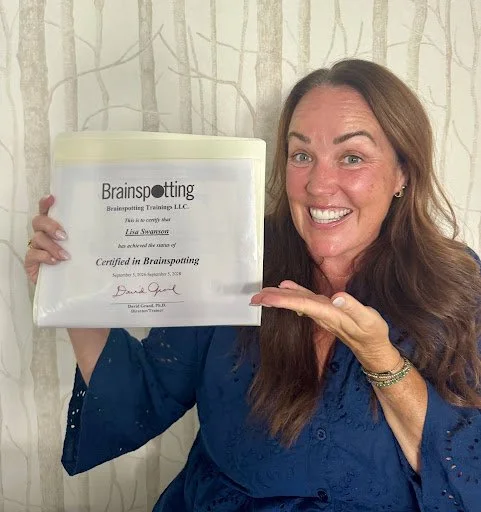
Why I became a Certified Brainspotting Practitioner—and why I believe so deeply in this work.
I am so excited to share that I have officially completed my Brainspotting certification!
I am now a Certified Brainspotting Practitioner, and I am extra proud to have this certification as a somatic coach.
Brainspotting certification isn't required in order to use the modality with clients, and I've actually had the training for quite some time. But completing the full certification process felt important to me. Because the work we do as somatic practitioners can sometimes look similar to therapy, I wanted to make sure I had the training, experience and framework to hold this work responsibly for the people who trust me with it.
But there's another reason Brainspotting means so much to me: I have personal experience with it.
Brainspotting was one of the modalities that helped me move through a place where I had been very, very stuck. I had done plenty of talking, thinking, analyzing and understanding. Intellectually, I knew what was happening in my life and I knew things needed to change. But knowing something and actually being able to move are two very different things.
Brainspotting helped me access some of what was underneath all that thinking—the emotions, patterns and experiences my brain could understand but my body hadn't quite worked through yet. And as those things began to process, something shifted. I was eventually able to take real action in my life.
That experience is a huge part of why I love this work with clients now.
So often we KNOW. We know the relationship isn't working. We know we want to make the change. We know we're ready for something different. We know what we “should” do. We've talked about it, analyzed it and maybe even made the pros-and-cons list. And yet, something in us still feels stuck.
Brainspotting gives us another way in.
One of the basic ideas behind Brainspotting is that where you look can affect what you access and process. Together, we find a particular point in your visual field—a “brainspot”—that seems connected to whatever you're working with. Instead of needing to talk your way through the entire story, we pay attention to what happens as you hold your gaze there. Emotions, thoughts, memories, images or sensations may arise. Sometimes the body responds. Sometimes something completely unexpected shows up.
And yes, this is why you may see me holding what some of my clients lovingly refer to as “the stick.” 😂 The pointer isn't magical. It simply helps us slowly move through the visual field and find a spot that feels connected to what you're working on.
What I love most about Brainspotting is that the goal isn't to stay in the processing forever. I want my clients to be able to work with the fears, blocks and places where they feel stuck, process what needs to be processed, and then get back out there and LIVE. I want you accessing your gifts, making changes, trying things, creating things and doing more of what you actually want to do.
So yes, I'm very freaking proud of this certification. Not simply because it's another piece of paper, but because I know what this work can feel like from both sides of “the stick.”
If you've wondered what Brainspotting actually looks like or what a session with me might be like, I made a little video explaining it.
I'm currently working with Brainspotting clients, so if something here made you curious about the work, you're always welcome to reach out.
xo,
Lisa
👉 Want more reflections like this? Make sure to subscribe to my newsletter for free breathwork session & to receive weekly plus weekly practices, insights, and inspiration to help you slow down, tune in, and reconnect.
👉 Curious about working together? Book a free call to explore how somatic support can help you feel more grounded, clear, and connected—no pressure, just a nourishing conversation to meet you where you are.